Minister’s Secretariat

Minister of Education & Human Resource Development, Ambassador David Claude Pierre

The Minister's Office serves as the central authority for strategic leadership, policy direction, and high-level coordination within the Ministry of Education and Human Resource Development (MEHRD). It supports the Minister in advancing the Government's education and human resource development agenda by providing strategic oversight, coordinating national priorities, strengthening stakeholder engagement, and ensuring effective governance across the sector.

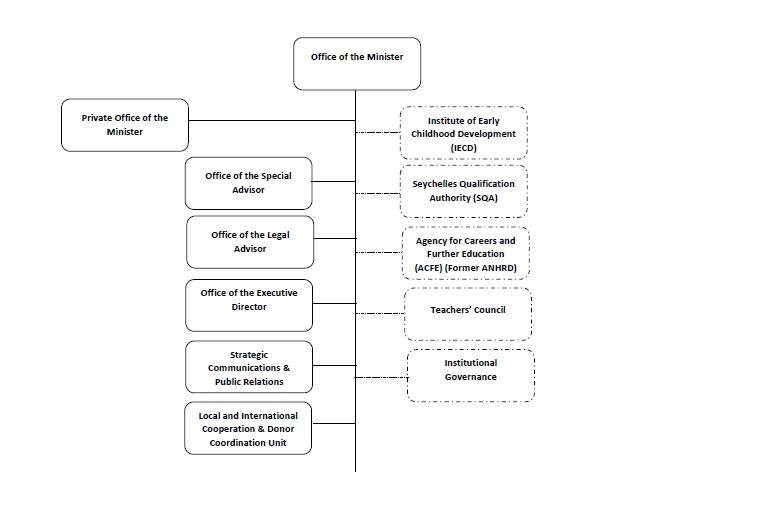
The Minister's Office comprises the following core offices and support functions:

Core Offices and Support Functions

a) Private Office of the Minister

Provides executive, administrative, protocol, and secretariat support to the Minister, ensuring the effective management of official engagements, correspondence, and ministerial business.

b) Office of the Special Advisor

Provides strategic policy advice, research, analysis, and guidance on priority initiatives, supporting informed decision-making and the implementation of Government priorities.

c) Office of the Executive Director

Coordinates the implementation of ministerial priorities, oversees cross-departmental collaboration, monitors strategic initiatives, and facilitates effective operational coordination across the Ministry.

d) Strategic Communications and Public Relations Office

Leads the Ministry's communication strategy by managing public engagement, media relations, corporate communications, stakeholder information, and the promotion of Ministry policies, programmes, and achievements.

e) Local and International Cooperation and Donor Coordination Unit

Coordinates national and international partnerships, manages donor-funded programmes and development cooperation, and strengthens collaboration with government agencies, development partners, regional organisations, and international institutions.

f) Office of the Legal Advisor

Provides legal advice and representation to the Ministry, ensures compliance with legislation and Government policies, supports the drafting and review of legal instruments, and advises on contractual, regulatory, and governance matters.

Oversight of Statutory Bodies and Public Entities

The Minister's Office provides strategic oversight, policy direction, and governance guidance to the Ministry's statutory bodies and public entities, ensuring alignment with national education priorities and legislative requirements. These include:

  • Seychelles Qualifications Authority (SQA), established under the Seychelles Qualifications Authority Act, 2005.
  • Careers and Further Education Agency (CaFEA), established under the Careers and Further Education Agency Act, 2026.
  • Institute of Early Childhood Development (IECD), established under the Institute of Early Childhood Development Act, 2014.

Associated Bodies and Governance Mechanisms

The Minister's Office also works closely with key advisory and governance bodies that strengthen professional standards, institutional accountability, and effective governance across the education sector. These include:

a) Teachers Council

Promotes and upholds professional standards, ethics, registration, and continuous professional development within the teaching profession.

b) Institutional Governance Structures

Supports effective governance, oversight, accountability, and strategic leadership across educational institutions through boards, committees, and other established governance mechanisms.

Strategic Role

Through these functions, the Minister's Office provides cohesive leadership and strategic oversight for the education sector, strengthens national and international partnerships, promotes sound governance and accountability, and ensures the effective implementation of Government policies and strategic priorities. It serves as the focal point for policy coordination, institutional stewardship, and whole-of-sector leadership, enabling the Ministry to deliver a high-performing, inclusive, and future-ready education and human resource development system.


The structure of the Office of the Minister is as follows:
Mandate

The Minister’s Office is responsible for providing strategic leadership, policy direction, and executive oversight for the Ministry of Education and Human Resource Development (MEHRD). Exercising its authority under the Education (Amendment) Act, 2017, the Office leads the implementation of the Government’s education and human resource development agenda while ensuring alignment with national priorities and development objectives.

The Minister’s Office provides overall stewardship of the education sector by overseeing the development of legislative and policy frameworks, directing strategic and operational planning, strengthening institutional governance, and monitoring the performance of the Ministry’s Departments and Public Entities. Through these functions, it ensures that the education system remains responsive, accountable, innovative, and focused on delivering quality outcomes for all learners.

Core Functions and Accountabilities

To fulfil its mandate effectively, the Minister’s Office operates through clearly defined governance structures and specialised units, guided by the Ministry’s principles of professionalism, integrity, accountability, collaboration, and service excellence.

Its core functions include:

a) Executive Support and Strategic Advisory

Providing high-quality executive, administrative, and policy support to the Minister, including strategic advice, evidence-based analysis, and coordination of ministerial priorities to facilitate informed decision-making.

b) Strategic Leadership and System Oversight

Providing strategic oversight of the Ministry’s Departments, statutory bodies, and national education initiatives to ensure effective implementation of Government policies, achievement of strategic objectives, and continuous improvement in sector performance.

c) Policy Coordination and Institutional Governance

Leading the development and implementation of legislative, regulatory, and policy frameworks while strengthening governance, accountability, and collaboration across the Ministry and its associated institutions.

d) Communication and Stakeholder Engagement

Managing strategic communications, public information, stakeholder engagement, and partnerships to strengthen public confidence, promote transparency, and foster collaboration with national, regional, and international partners.

e) International Cooperation and Resource Mobilisation

Coordinating international cooperation, development partnerships, and donor-funded programmes to mobilise technical and financial resources that support national education priorities.

f) Legal and Regulatory Services

Providing legal advice and regulatory oversight to ensure that the Ministry’s policies, programmes, contracts, and operations comply with applicable legislation and Government requirements.

Organisational Units

The Minister’s Office comprises the following specialised units, each supporting the effective delivery of its strategic mandate:

Office of the Special Advisor

Provides strategic policy advice, research, and evidence-based analysis on emerging educational issues, supporting innovation, system reform, and informed decision-making across the education sector.

Office of the Executive Director

Coordinates the implementation of ministerial priorities, oversees cross-departmental collaboration, strengthens organisational performance, and ensures the efficient management of Ministry operations.

Local and International Cooperation and Donor Coordination Unit

Leads the development and management of partnerships with Government agencies, development partners, regional organisations, and international institutions, while coordinating donor-funded programmes and promoting effective resource mobilisation.

Strategic Communications and Public Relations Office

Develops and implements the Ministry’s communication strategy, manages media relations and public engagement, oversees digital communications, and promotes the Ministry’s policies, programmes, and achievements.

Office of the Legal Advisor

Provides legal counsel to the Minister and senior management, supports legislative development, manages legal risks, and ensures compliance with statutory and regulatory requirements.


Statutory Bodies and Associated Institutions

The Minister’s Office provides strategic oversight and policy guidance to the Ministry’s statutory bodies and associated institutions, ensuring effective governance and alignment with national education priorities.

Seychelles Qualifications Authority (SQA)

Serves as the national regulatory authority responsible for the Seychelles National Qualifications Framework, quality assurance, accreditation, and the recognition of qualifications to ensure the credibility, relevance, and international comparability of education and training programmes.

Careers and Further Education Agency (CaFEA)

Promotes career development, lifelong learning, and access to further education by providing career guidance, educational counselling, and workforce planning services that respond to national labour market needs.

Institute of Early Childhood Development (IECD)

Provides national leadership in Early Childhood Care and Education through policy advice, research, professional development, technical support, and stakeholder coordination to promote the holistic development and wellbeing of young children.

Teachers Council

Promotes excellence within the teaching profession by establishing professional standards, supporting continuous professional development, upholding ethical practice, and advising on matters affecting the education profession.

Institutional Governance

Strengthens governance, accountability, and leadership across educational institutions through effective governance structures, policy oversight, and performance monitoring that support continuous institutional improvement.

Access to Information

In accordance with the Access to Information Act, 2018, the Ministry is committed to promoting transparency, accountability, and public access to information. The designated Access to Information Officer coordinates requests for information, ensures compliance with statutory requirements, maintains appropriate records, and prepares the Ministry’s annual statutory reports to the Information Commission.

Executive Committee

The Executive Committee serves as the Ministry’s highest executive management body, providing strategic leadership, policy oversight, and institutional direction. Chaired by the Minister and comprising the Ministry’s senior executive leadership, the Committee is responsible for guiding strategic decision-making, monitoring organisational performance, coordinating cross-cutting initiatives, and ensuring effective implementation of Government priorities across the education sector.

Through its collective leadership, the Executive Committee promotes sound governance, strengthens institutional accountability, and drives the continuous improvement of the Ministry’s performance and service delivery.

A quick tour of neospin instantly provides an overview of the many possibilities on offer. Available bonus funds can be used in most game categories of the casino. Special English-speaking tables are available at certain times of the day. Instant transfer services such as Trustly or Klarna are also included in the payment portfolio. The game selection comprises several thousand titles from renowned software developers such as NetEnt, Microgaming and Pragmatic Play. The support team is familiar not only with the platform but also with technical details. Personal game lists and favourites ease quick access to preferred titles. Players can close their account temporarily or permanently at any time as needed. Players have the possibility to compete with each other in direct duels. Smartphones and tablets from all known manufacturers are supported without limitation. The positive response from the community confirms the impression of an all-round successful platform.

Ministry of Education
Right Menu Icon